The season’s first named storm triggered deaths, mass outages and transport disruption — and exposed how quickly “weather” becomes an economic and governance test.
LONDON / DUBLIN / PARIS — When the UK Met Office named Storm Amy on 1 October, it framed the system as the first named storm of the 2025/26 season, with forecasts of rapidly strengthening winds and heavy rain as it approached the British Isles on Friday and into Saturday.
By the time Amy arrived, the meteorology was almost secondary to the operational reality: in a densely connected economy, a storm is no longer a “weather story”. It is a stress test for electricity networks, transport, emergency response and public communication — and a proxy for how resilient states are under pressure.
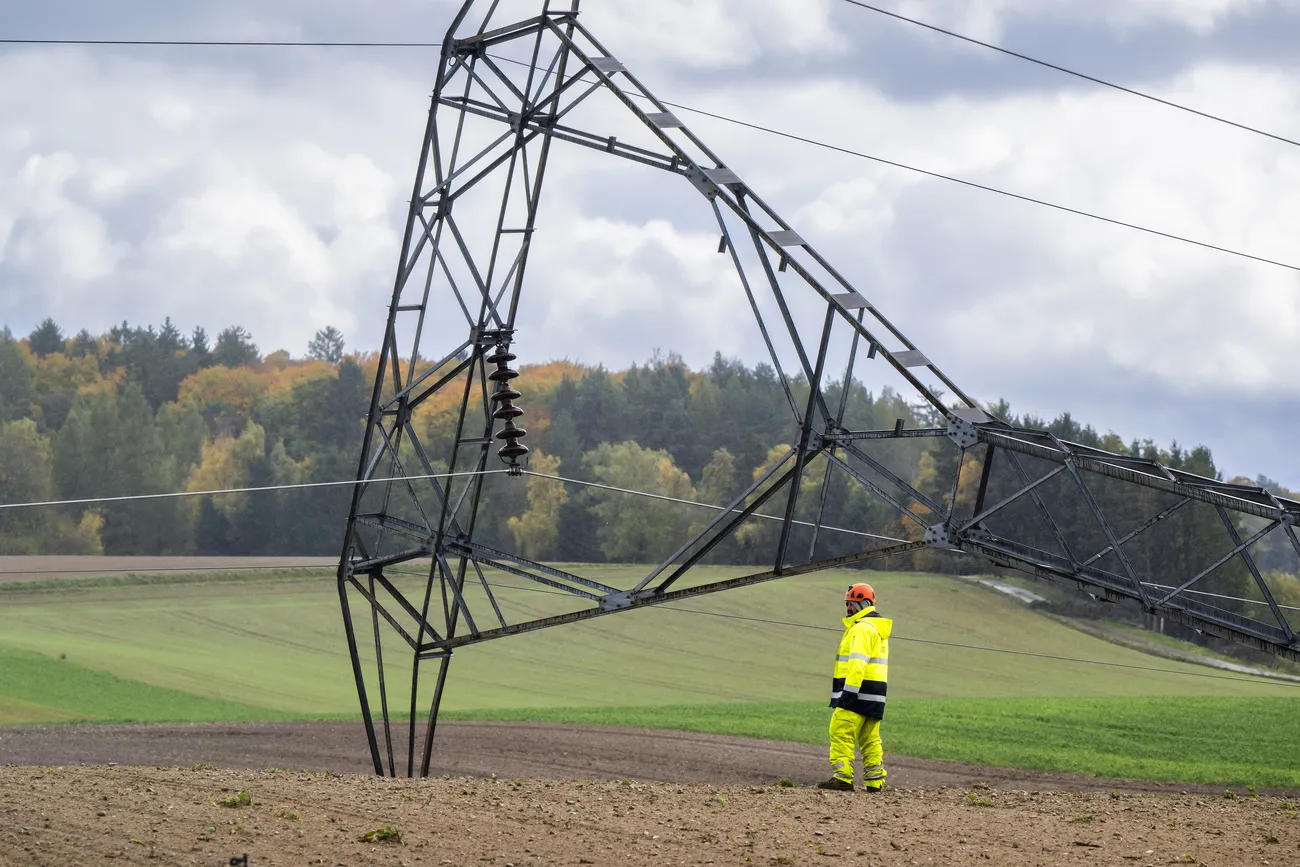
The first sign of systemic strain came through the grid. ESB Networks said that by 5:15pm on Friday 3 October, around 184,000 homes, farms and businesses in Ireland were without power, concentrated across western and northwestern counties. It warned that hazardous conditions and accessibility constraints would slow restoration and that further outages were possible as warnings remained in place.
This is the modern resilience problem in one statistic: when power fails at scale, disruption is no longer local. It cascades into commerce (closed shops, card terminals and cold chains), services (communications and public transport) and household safety — all while repair becomes harder precisely when demand for repair becomes highest.
A cross-border shock, with uneven consequences
In France, where the storm’s most intense impacts were not the primary forecast story, the human cost still materialised. On Saturday 4 October, TF1 reported two deaths linked to conditions during the storm — one in Seine-Maritime and one in the Aisne — as departments faced orange-level warnings for violent winds.
The broader point is that “glancing blows” can still produce fatalities and serious disruption. The threshold for severe impact is lower than it used to be because exposure has risen: more mobility, more dependence on electricity and connectivity, and tighter supply chains.
In the UK and Ireland, the scale of disruption was visible in transport and public safety measures. Reporting on 3 October described widespread travel disruption, with severe warnings across Ireland and parts of the UK, alongside major power cuts and emergency incidents as winds intensified.
Why storms now behave like strategic risks
The policy lesson is not simply “prepare for storms.” It is that critical infrastructure has become the economy’s nervous system — and failures are felt faster and more broadly than institutions were designed for.
Three dynamics make events like Amy disproportionately expensive:
1) Repair is the bottleneck, not detection
Utilities and authorities often know what is happening quickly. The constraint is mobilisation under unsafe conditions. ESB Networks explicitly warned that restoration would be limited by hazardous weather and access challenges — a reminder that resilience is partly physical geography and logistics, not only funding or planning.
2) “Weather” is now a compound event category
The Met Office guidance highlighted strong gust potential and heavy rain across exposed areas, which matters because combined wind-and-rain events drive compound failures: trees down on lines, blocked roads slowing crews, and broader transport disruption amplifying economic impact.
3) Warning systems face a credibility trade-off
Storm naming and colour-coded alerts improve clarity — but frequent warnings risk fatigue. The Met Office’s storm-naming decision and its public messaging show authorities trying to keep compliance high while uncertainty about track and severity persists.
The economic angle policymakers often miss
In fiscal terms, storms generate costs that arrive in layers:
- Immediate response (emergency services overtime, temporary closures, safety operations)
- Restoration (repairs, contractor surges, replacement of damaged assets)
- Second-order economic loss (lost trade, disrupted logistics, productivity hits)
- Political cost (perceived inequity in restoration speed, rural vs urban exposure)
Amy illustrates that what looks like a 24–48 hour event can carry multi-week consequences for affected regions — particularly when outages cluster in less dense areas where repair is slower and economic buffers are thinner.
What this means for resilience policy
Europe increasingly discusses “security” in terms of borders and defence. Storm Amy argues for a parallel doctrine: resilience is not only climate policy; it is state capacity.
The practical agenda is unglamorous — vegetation management near lines, hardening vulnerable nodes, redundancy planning for communications, and pre-positioning repair capability when warnings rise. But those details are precisely where resilience either exists or collapses.
Amy did not redefine Europe’s weather risks. It clarified something more important: the continent’s economic model is only as robust as its ability to keep electricity and transport functioning under stress — and to restore them quickly when they fail.