Container traffic is edging back through the Bab al-Mandab corridor. But the insurance market, not the shipping lines, is setting the new baseline for risk — and that baseline implies volatility is structural, not temporary.
LONDON / CAIRO / DUBAI — The Red Sea is moving again.
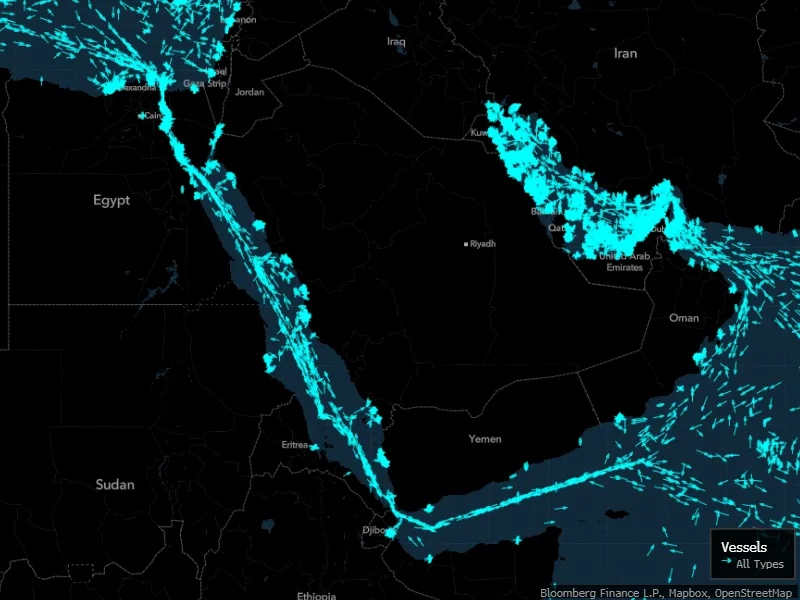
By early December, more container lines had resumed limited transits through the Bab al-Mandab and Suez corridor, reversing the blanket avoidance that defined much of 2024 and early 2025. Egypt’s Suez Canal Authority reported stabilising revenues and improving transit counts compared with the lowest points of disruption.
On the surface, the signal appears reassuring: shipping is flowing, detours around the Cape of Good Hope are declining, and voyage times are shortening.
But beneath the surface, the insurance market is telling a different story.
The repricing that didn’t reverse
War-risk premiums for Red Sea passages have declined from peak levels — yet they have not returned to pre-crisis norms. Insurers are still embedding a structural risk surcharge into transit pricing, reflecting two realities:
- Capability remains intact. Armed actors in Yemen have not lost the ability to target shipping; they have chosen not to exercise it at scale.
- Trigger volatility remains high. A deterioration in Gaza or broader regional tensions could re-open the corridor to disruption quickly.
This shift from “acute risk” to “embedded volatility” is December’s real development. Shipping lines are adjusting routes; insurers are adjusting assumptions.
Maritime security becomes architecture, not emergency
Another structural change is operational.
Naval patrol coordination in the Red Sea has moved from reactive escort operations toward more formalised security architecture — shared maritime domain awareness, tighter coordination with commercial operators, and a clearer reporting protocol between insurers, navies and carriers.
The corridor is no longer treated as an exceptional theatre; it is being absorbed into routine high-risk navigation management.
That normalisation is a paradox. It improves predictability — but it also institutionalises the expectation that the Red Sea is now a semi-permanent high-risk zone.
Egypt’s balancing act
For Egypt, the stakes are fiscal. Suez Canal revenues are not only a transport metric but a balance-of-payments stabiliser.
December data suggest improvement from the lowest disruption months. Yet revenue recovery is fragile because traffic remains sensitive to insurance pricing and geopolitical headlines. A single escalation could re-divert fleets within days.
Cairo’s interest, therefore, is not only de-escalation but predictability — something neither insurers nor regional actors can fully guarantee.
Europe’s exposure is quiet but real
Europe is the terminal node of much of this corridor’s traffic.
Energy flows, industrial components, consumer goods and intermediate manufacturing inputs all move through the Suez–Mediterranean chain. Even modest insurance premiums translate into cumulative cost pressures across supply chains.
The Red Sea disruption of 2024 taught European firms to adapt; December 2025 is teaching them to assume volatility.
Houthi signalling and the credibility gap
The de-escalation signal tied to the Gaza ceasefire created space for return traffic. But that signal remains conditional.
When armed actors publicly link maritime security to political developments elsewhere, the corridor becomes a bargaining instrument. Markets react not only to missiles — but to statements.
December’s structural shift is that shipping companies now model those statements as part of their risk calculus.
The new baseline
Red Sea 2.0 is not the crisis phase. It is the volatility phase.
Traffic flows, but at a premium. Naval patrols operate, but under expectation of recurrence. Insurance markets hedge, but do not relax.
The corridor has not stabilised back to 2019 normality. It has stabilised into a managed-risk environment — one that assumes shocks will return.
For Europe, for Egypt, and for global trade, that distinction matters.