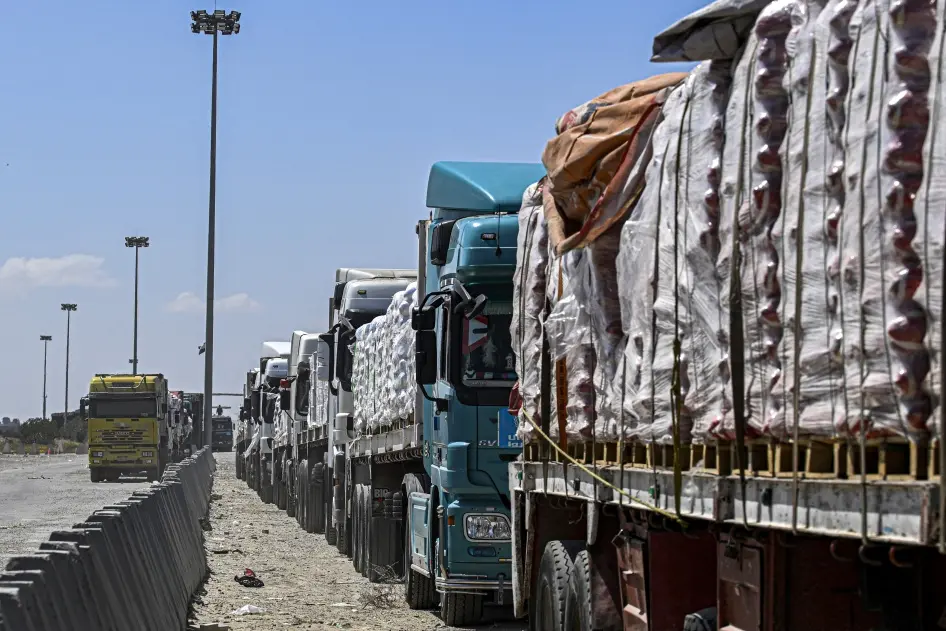
Fighting has not fully resumed. Aid continues to move. But by mid-December, negotiations over governance and long-term security arrangements have slowed, exposing the central weakness of the October truce: it paused violence without defining authority.
CAIRO / DOHA / TEL AVIV — The Gaza ceasefire has entered its most dangerous phase: the quiet one.
In early December, mediators from Qatar, Egypt and the United States were still engaged in talks aimed at moving the truce from phase one — hostage exchanges, limited pullbacks and humanitarian scale-up — into a more durable phase-two framework. But momentum has slowed, and the political architecture required for long-term stability remains undefined.
The ceasefire is holding in a narrow sense. It is not consolidating in a strategic one.
The governance gap
The core dispute is no longer over troop movements or exchange ratios. It is over who governs Gaza after the ceasefire stabilises.
Three competing realities are visible:
- Israel has insisted on security guarantees and mechanisms preventing Hamas from reconstituting military capacity.
- Hamas seeks survival and political continuity, even if under modified structures.
- Regional mediators aim to avoid a vacuum that could invite renewed escalation or uncontrolled fragmentation.
December’s drift reflects the difficulty of reconciling those positions without a clear administrative blueprint.
The absence of a transitional governance framework — whether technocratic, internationally supervised, or Palestinian Authority-linked — means reconstruction pledges cannot fully unlock. Donors hesitate when authority lines are unclear.
Reconstruction finance meets political ambiguity
Financially, Gaza’s rebuild depends on scale. Billions pledged in principle require predictable channels for contracting, oversight, and security guarantees.
Without clarity on:
- who authorises projects,
- who controls internal security,
- and who signs procurement agreements,
capital remains conditional.
December has therefore exposed a structural truth: ceasefires create room for reconstruction, but reconstruction demands governance.
Enforcement fatigue
Another emerging theme is enforcement fatigue.
Phase one relied heavily on intensive shuttle diplomacy and crisis-management bandwidth. As weeks pass, mediators face diminishing leverage unless progress toward a defined second stage is visible.
Conditional ceasefires are inherently fragile: the longer negotiations stall, the more each side tests boundaries — through political signalling, security operations below escalation thresholds, or rhetorical positioning.
December has not produced collapse. It has produced friction.
The regional calculus
Gaza’s future governance intersects with broader regional considerations:
- Egypt’s security concerns in Sinai.
- Qatar’s role as mediator and financial conduit.
- Gulf states weighing reconstruction participation.
- Israel’s internal political constraints.
- US electoral timing heading toward 2026 mid-cycle positioning.
The risk is not immediate war, but structural stagnation — a semi-frozen conflict with periodic flare-ups and no defined political endpoint.
The strategic shift
What changed in December is not violence levels. It is confidence.
October produced urgency. November produced implementation. December has produced hesitation.
A ceasefire without a phase-two roadmap begins to look less like a bridge and more like a holding pattern.
History suggests holding patterns rarely last.