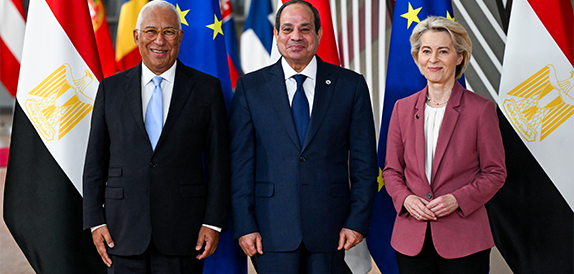
The first EU–Egypt summit in Brussels formalised a strategic partnership backed by €7.4bn — tying trade, investment and research cooperation to Europe’s priorities on migration and regional stability.
BRUSSELS — The EU hosted the first-ever EU–Egypt summit on 22 October 2025, bringing together European Council president António Costa, Commission president Ursula von der Leyen and Egyptian president Abdel Fattah el-Sisi in what EU officials described as a milestone: not only the first bilateral summit between Brussels and Cairo, but also the EU’s first bilateral summit with any Middle East and North Africa country.
The summit’s political logic was straightforward. Egypt sits at the intersection of Europe’s most sensitive external files — Gaza diplomacy, Red Sea/Suez insecurity, migration routes, and energy and trade corridors — and Brussels is increasingly trying to turn ad-hoc crisis management into a more durable “Mediterranean architecture” anchored by a handful of regional states.
Money, access and leverage
At the centre of the partnership is a €7.4bn financial and investment package for 2024–2027, intended to support economic stabilisation and investment while strengthening cooperation across the partnership’s pillars. The EU said it had already disbursed €1bn in short-term macro-financial assistance in December 2024, and that a Memorandum of Understanding underpinning a further €4bn package — focused on economic stability, competitiveness and the green transition — was signed on the margins of the summit.
This structure matters because it quietly turns the relationship into an implementation test. The EU is not only offering support; it is designing a pipeline of assistance that can be accelerated, slowed, or conditioned — and Cairo, facing acute economic pressures, has a clear incentive to keep the pipeline moving.
Trade and research as strategic glue
Brussels also used the summit to reinforce the “normal” state-to-state foundations that make security partnerships stick. The EU pointed to the EU–Egypt Association Agreement (in force since 2004) and signalled openness to modernising the relationship to better fit current challenges, while re-emphasising the free-trade area framework.
In parallel, leaders signed agreements including Egypt’s association with Horizon Europe, and a joint statement linked to financing for socio-economic development — moves that widen the relationship beyond migration and crisis diplomacy into innovation, education and industry links.
Migration and security: the unspoken centre of gravity
Official readouts framed the summit as cooperation on shared regional and global challenges — the Middle East, Ukraine, multilateralism, trade, migration and security — but the political centre of gravity is clear: Europe wants credible partners on migration management and regional stability, and Egypt wants predictable financing and investment amid inflationary strain and regional disruption.
That bargain has an unavoidable reputational and political edge. Human rights organisations have urged the EU to press Cairo on rights concerns as it deepens cooperation, highlighting a familiar European dilemma: how to pursue stability and migration control without appearing to trade away values for short-term containment.