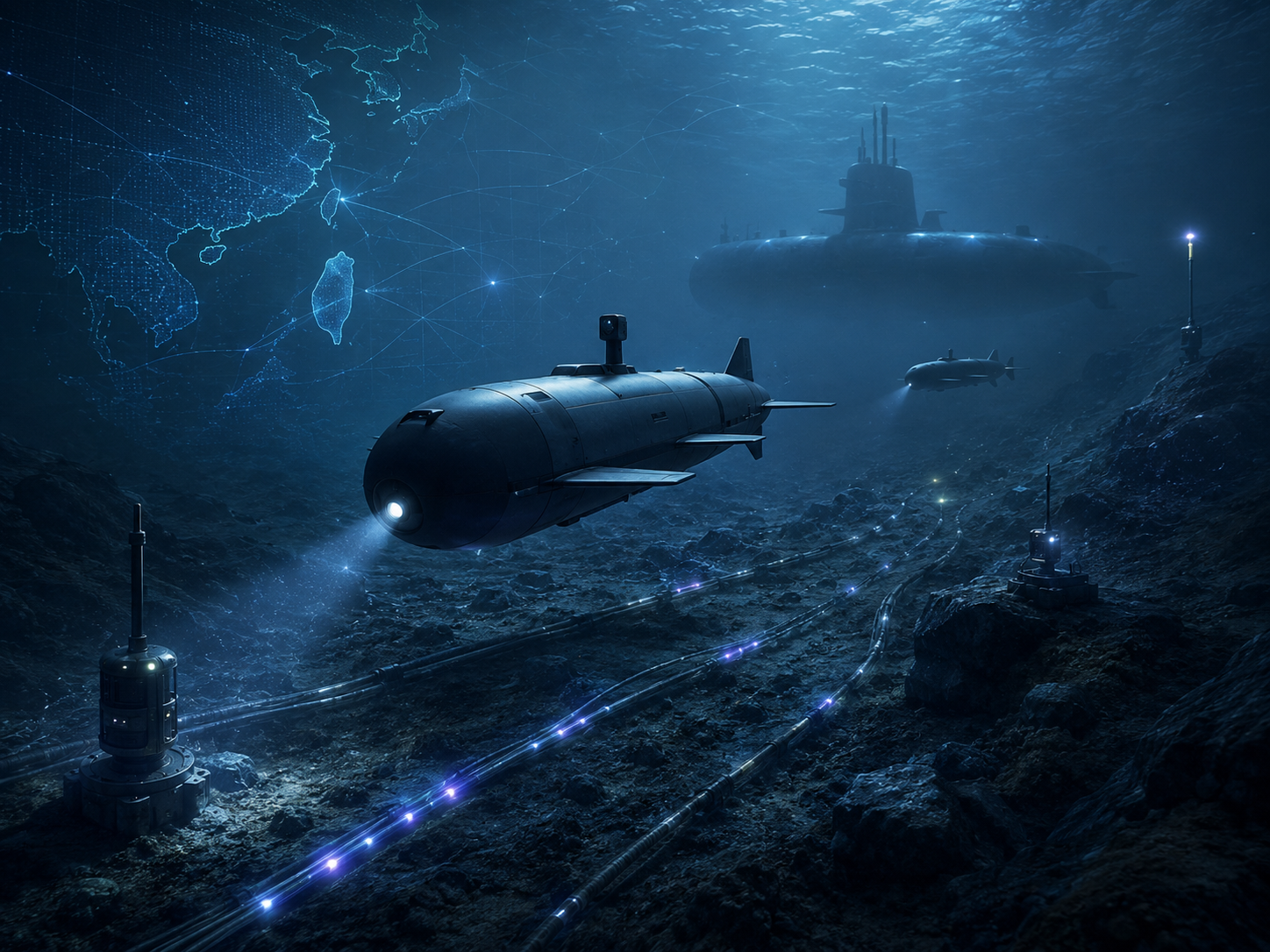
On 30 May 2026, Australia, the United Kingdom, and the United States announced the first AUKUS Pillar II Signature Project: cutting-edge payloads and enabling systems for AUKUS partners’ Uncrewed Undersea Vehicles, with delivery starting in 2027. The announcement, made on the sidelines of the Shangri-La Dialogue in Singapore, is the clearest operational signal yet that the three-nation pact has shifted from institutional architecture to deployable hardware.
The programme will improve reconnaissance and strike capabilities, and bolster superiority in anti-submarine and anti-surface warfare, mine countermeasures, electronic warfare, and contested littoral manoeuvre, the joint statement read. It will specifically support the development of payloads — sensors and weapons systems — deployable across the three nations’ UUV fleets.
U.S. Secretary of Defense Pete Hegseth, speaking to reporters in Singapore, described the programme as delivering “a suite of highly adaptable multi-mission UUV payloads designed to support undersea operations and maintain our collective advantage in the maritime domain.” UK Defence Secretary John Healey said the vehicles would sharpen all three countries’ ability to respond to threats, including those targeting underwater cables and pipelines.
The cable framing is not rhetorical. Undersea cables carry over 99 percent of global digital traffic and support military coordination, financial markets, and digital infrastructure. Taiwan alone depends on 24 undersea cables — 14 international and 10 domestic — for connectivity ranging from internet use to global financial transactions. A prolonged disruption would cost an estimated $55 million per day, before factoring in global semiconductor supply chain shocks.
The state-owned China Ship Scientific Research Center, part of China’s largest shipbuilding conglomerate, and another Beijing-affiliated body, the State Key Laboratory of Deep-Sea Manned Vehicles, disclosed in early 2025 that they had developed a ship capable of cutting cables at depths of up to 4,000 metres. The U.S.-based Center for Strategic and International Studies, reporting in April 2025, concluded that by unveiling such a vessel China had “laid bare that it regards sabotage and other intentional alteration of cables as just another coercive move in its playbook.”
The operational record supports that assessment. Between January and February 2025, Taiwan experienced four incidents of submarine cable disruptions — three domestic and one international. Disruptions between Taiwan and its offshore islands were linked to Chinese vessels including the Xingshun 39 and Hongtai 58, operating under deceptive identities. In November 2024, two major subsea cables connecting Finland and Germany, and Sweden and Lithuania, were damaged within 24 hours of each other, with Chinese bulk carrier Yipeng 3 later discovered operating close to both damaged sites; joint investigations by Danish, German, and Swedish maritime authorities found physical evidence of tampering.
This is not coincidental geography. Raymond Powell, founder and director of SeaLight at Stanford University, told The Diplomat in January 2025 that the employment of third-country-flagged cargo vessels to carry out undersea cable and pipeline sabotage operations “appears to be a new element in Beijing’s ongoing gray zone warfare against Taiwan.” By flooding strategic waterways with AIS-transmitting vessels to mask the movements of specialised ships, Beijing has created a “fog of sea” in which identifying intentional sabotage becomes nearly impossible for international observers until the data blackout has already begun.
The undersea competition, however, extends beyond gray-zone cable harassment. According to a February 2026 report by the International Institute for Strategic Studies, China’s nuclear submarine production now surpasses that of the U.S., rolling out 79,000 tonnes of displacement from 2021 to 2025, compared to only 55,000 by the U.S. Rear Admiral Mike Brookes, from the U.S. Office of Naval Intelligence, highlighted in March 2026 that China’s submarine force could reach roughly 70 submarines by 2027 through the addition of six nuclear-powered guided-missile submarines, three smaller-class nuclear-powered attack submarines, and two ballistic missile submarines.
China has also deployed two “XXL” uncrewed submarines to Hainan in the South China Sea, where they appear to be undergoing trials; the two designs may represent competing prototypes. These latest types are approximately 10 to 20 times larger than what passes for an extra-large UUV in Europe. The AUKUS Pillar II UUV programme is thus being fielded into a domain Beijing has been contesting with hardware, not just harassment.
AUKUS’s own near-term posture is consolidating rapidly. Defence ministers announced at Shangri-La the finalisation of arrangements needed to establish Submarine Rotational Force-West at HMAS Stirling in 2027, which will support submarine deployments by expanding maintenance options and sustainment infrastructure. The United States has authorised the establishment of U.S. Navy support elements for SRF-West, with the first rotation of a U.S. nuclear-powered submarine to the Australian base expected in 2027, followed by a UK Astute-class submarine. The Australian Government is investing up to A$8 billion to expand Stirling’s infrastructure.
The UK described the latest announcements as building on the Geelong Treaty signed in July 2025, which established a framework for the deepest level of UK-Australian defence cooperation in generations. The SSN-AUKUS programme has been supported by investments from both countries, including £6 billion committed by the UK in 2025.
The second-order implication most market participants are under-pricing is the bifurcation of undersea cable infrastructure along alliance lines — and its pricing consequences. Nearly $11 billion of investment in new cables entered service between 2024 and 2026, with Chinese-owned HMN Tech holding approximately 5% market share over the same period despite cost-competitive pricing. FCC rules announced in August 2025 created a presumption of denial for cable-landing licence applications from entities linked to designated foreign adversaries, and banned equipment from vendors on the agency’s Covered List from any submarine cable system connecting to the United States. At an estimated cost of $6,000 to $20,000 per kilometre, an additional 100 km in routing to avoid Chinese maritime territorial claims can add between $600,000 and $2 million in project costs.
The UUV announcement accelerates that bifurcation by pricing in physical enforcement. UUVs capable of persistent seabed surveillance will make cable corridor patrolling tractable at scale for the first time — creating a meaningful deterrent where, previously, geography and repair lag time were the only barriers to gray-zone interdiction. In PLA doctrine, cutting cables is an early pre-invasion step; by targeting chokepoints near the Bashi Channel alone, China could theoretically reduce Taiwan’s international bandwidth by up to 95%. A persistent autonomous AUKUS presence on critical cable routes changes that calculus, even before the first system reaches operational service.
UK Defence Secretary Healey acknowledged publicly that “for too long in AUKUS, we talked too much and delivered too little.” The Pillar II Signature Project is a partial answer to that criticism — but its value depends entirely on execution timelines that remain conditional. The 2027 delivery date for initial UUV capabilities sits alongside 2027 for SRF-West’s first nuclear-submarine rotations and 2027 for the Pillar II payloads themselves. A simultaneous delivery of all three would represent a qualitative step-change in allied presence below the waterline.
For capital allocation, the implication is directional rather than binary. The securitisation of cables is already reshaping the physical layout of regional cable architecture as investments are redirected to account for changing understandings of risk. Defence-industrial firms with autonomous underwater vehicle, mine-countermeasure, and seabed sensor portfolios — particularly those already embedded in AUKUS supply chains — would probably see order books expand faster than consensus currently prices. Sovereign cable operators with exposure to routes through contested South China Sea chokepoints carry a risk premium that conventional credit analysis is still systematically underweighting. That gap is likely to close.